Days 9-10: Extraordinaires Design Sprint

For the  past two days, students in NOVA Lab have been experiencing the entirety of the Design Thinking Mindset through the amazing “Extraordinaires Design Studio@Extraordinaires by Hub Games (@wearehubgames) .

I’ve worked with this product before, with middle school students in 2016-17 in a middle school pilot for the company, and also with MS teachers and teachers from around my district as a focus for 1/2 day workshops.  I’ve yet to see this product fail in helping people new to DT actually engage with empathy and discover clear needs for their characters.

So when it was time to introduce my students in NOVA Lab to Design Thinking, of course I hit up my Extraordinaire’s Design Studio kits and let the kids fly.  Here are some observations over the past two days from students:

Spy

Period 9, 9/11/19

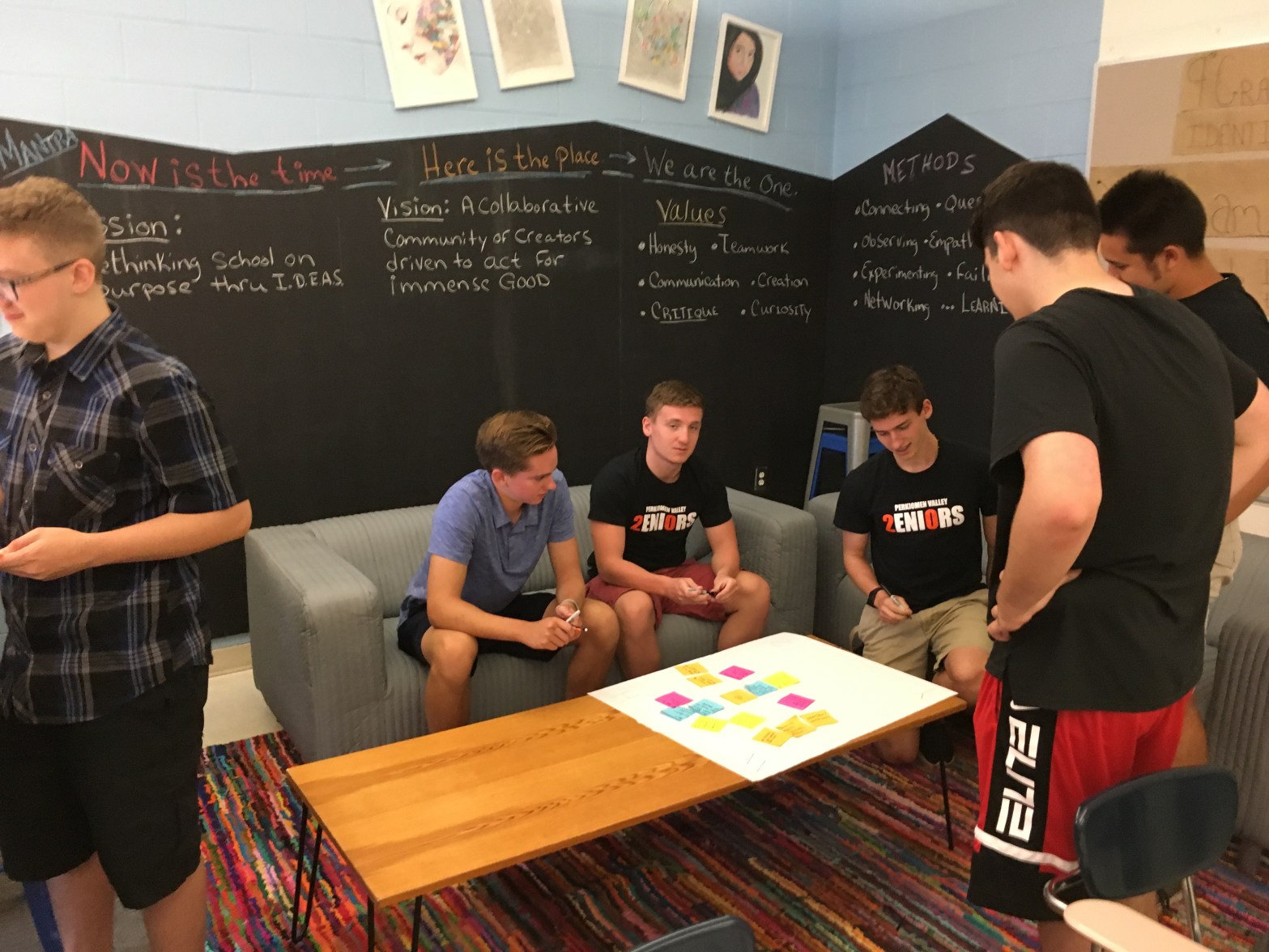
Today’s class began with students pairing up with their partners (which were decided upon during yesterday’s class). Partners then discussed their Extraordinaire character, including details such as their physical appearance, occupation, and day to day activities. The characters on the cards appeared to be facing some sort of obstacle or event in their lives, whether it be not fitting in at school or being a superhero solving crime all while trying to be there for her kids. After examining and recording the observations made about the characters, a set of partners was then paired with two more students who had the same character card as them. By becoming a group of four, it created a larger discussion about a common character and their daily battles. Additionally, adding more people to the group brings new ideas, therefore students gain more perspectives and thoughts on one character that they could have overlooked previously. This group later prepared a general outline as to what their character’s daily routine might include, as well as proposed three necessities for their character. Students wrote their ideas of what the characters’ needs are in a flow chart, followed by their explanation as to why they believe their character needs that particular item. After organizing these ideas, students created one sentence that combined the characteristics, needs, and daily activities of a single character in a short phrase. 


This slideshow requires JavaScript.

So, why is this significant? Discussing the characters’ daily activities and what their emotions might be (from what we can see in the photos) allows students to feel empathy for these characters. Observing characteristics and daily routines allows students to get a better understanding of what the character endures every day and how it creates an impact on their life. 

What’s next? Now that NOVA Lab students are beginning to grasp the idea of empathy, and how it differs from sympathy, it gives them more of an ability to solve problems. This is because it is difficult to solve a problem for someone without putting oneself in their position. Now that students are able to do this and feel for others, it gives them endless opportunities to help others and solve issues. 

Emma C.

Period 3

Today in Innovation Lab we dove further into figuring out how we can help our character that we looked at on the card. We started out by reviewing and observing the card one again, then after that we discussed with our partners about a day in the life of our character. This exercise is a practice of empathy, but also with our problem finding/solving skills. After this, we joined with another group with the same card and began discussing what our empathy map would look like. This helped us establish a need for the character. For instance, we had the “rap star” card and we decided that he needed success to help provide for his family. Mr Heidt generously provided a worksheet where we could write down our thinking in an organized manner. After we had our thoughts down, Mr Heidt let us know about the 10 traits that a superintendent and a CEO would want in a worker. The Superintendent said Problem Solving, but the CEO said Problem Finding. We had a discussion about why this might be, then Mr. Heidt left us with an assignment to sketch out a way to solve the character on our card’s problem. Tomorrow we will get more involved with the solution to my “rap star”’s problem. 

–Dylan A.


Tuesday, 9/10, 2019

Period 9.

In today’s class, everyone started off with a game called “Long Lost Friend”. It involved ad-libbing a conversation based on a singular topic. A prompt would be similar to “you just met someone who is your long, lost friend, or you should not have met”, and 2 people would have to freestyle act their way through a chat. After that, we spent the rest of the time on an activity called “Extraordinaires Design Studio”.

For this activity, every two people would be given a card that features a rather comical person and background, such as a superhero, wizard, or pirate. Each person had a background to match their occupation. On the back, the card showed 3 images, something surprising about the person, a picture pertaining to their day-to-day life, and a little detail about something in a setting they are commonly found in.


So we all have cards with rather comical outlooks on fantasy characters, great. What’s the point? Well, we all had to do something with these cards (or rather, about them). Looking at the pictures and details about these people, the students were tasked with creating an empathy map for their person. This involves 4 main criteria: their raw appearance, the environment they are most found in, details relating to their occupation, and any other observations that could be made here. Most of these details were inferenced from the images, and few were grounded in fact.

What’s the point?

In the mind of most designers, they have to start by thinking about 1 question: What is a problem in people’s lives, and what can be done about it? A similar phrase covers a wall in our classroom right now. In order to solve a problem, people have to empathize with others and their struggles in an area. This “design studio” was made to build empathy for a person, even if it’s a comical one. It is meant to get the class started on thinking in the empathetic track, to begin the true purpose of this class. It is an “Innovation Lab”, after all.

Alright, we are learning to empathize. What happens next?

Well, we have empathy down, sort of. There is still much more to go on that topic, but the seeds have been planted. After empathy, the next step would be design. It is soon time to begin a design sprint, to gather ideas and begin experience in that part. Now that students have a grasp on empathy that will only get better with time, the closer we become to starting the design process. Not only that, but the bulk of the year’s work approaches that much more.

Nova Lab Day 8: Disruptus Amongus

‘Broke out the good ‘ol “Disruptus” box and moved kids through a quick cycle of combinatory innovation.  Presentations had to point to what the original objects were, then who they designed for, why they needed it, and how it worked.  Though light-hearted, the presentations were prefaced by asking students to treat themselves as professionals.  That’s something we’ll always be working towards.

Here’s a student’s take on the day…


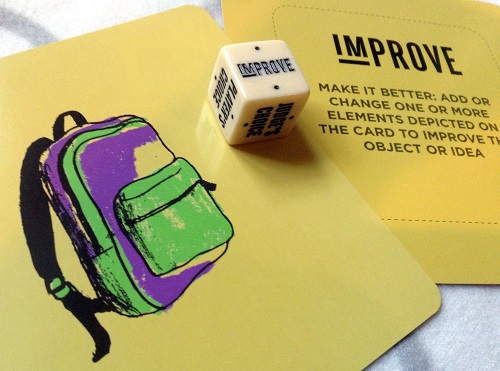
500disruptusimprovethebackpackjpg
Image found here

“What happened?

So today in class we picked up with our activity from the previous day which was our Disruptus picture combination. We sat together in our groups from the beginning of class and started to brainstorm and wrap up our combination ideas. After that, each group took turns presenting in front of the class and we all had a great laugh. For some examples, we had a group that combined a recycle bin and a submarine. Since they explained that they had access to military technology, they had a sensor placed in the recycle bin to detect for racoons trying to make an entrance. Once the motion sensor went off, the submarine would launch a missile and blow up everything in a 4 kilometer diameter. Not the greatest solution, but I guess it solved the problem. After every group presented we went over where we were on the road map and analysed the reason for this mini project. 

So what? 

This project, whether or not we all realised, challenged all of the students’ abilities to problem solve, and think creatively to find a way to combine their crazy objects, and find a solution to a problem they found. Also, for the new kids who have never had Mr. Heidt and are nervous in the class, they stepped up and presented in front of the class. Whether or not they said a lot, they’ll feel more comfortable going forward. I know it made me feel really scared when I was up there, but once it was over, I realised it wasn’t so bad.

Overall, the students’ ability to find solutions to many problems and think of ways to combine two completely different objects is representative of a piece of the innovator and entrepreneurial skillsets we are focussing on in class this year.

IMG_0910
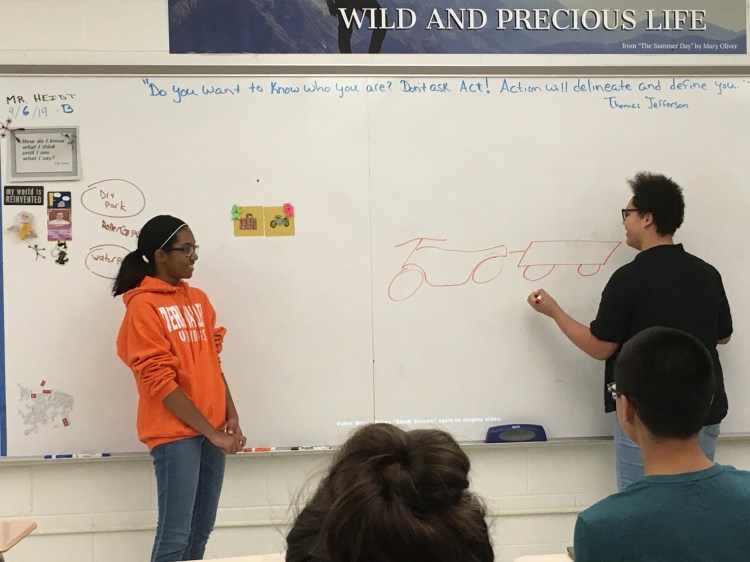
Students combine a motorcycle and a hospital…

Next what?

Now that we have created a closer community of innovators, we can start to focus more on our opportunities and how we can change schools for the better. Hopefully, we can still work on building relationships in the future and having a great laugh. Keep on creating mantras to help boost our confidence and our ability to produce new innovative ideas. Overall, I look forward to what we do next in class, I truly never know which is why it is such an amazing experience to learn and think about the future of Innovation Lab.

-Cole C

*Header Image found here

NOVA Lab Day 7–Getting on the Map

Period 3

What happened?

  • Today in class, we started things off with a game of Funk, Monk, Dunk, which is Rock, Paper, Scissors but more raucous and entertaining. The goal was to learn the names of and then cheer for other people in the class. After Funk, Monk, Dunk, Mr Heidt gave us a layout of what the year is going to look like. This was our first true taste of the “syllabus,” but for Innovation Lab I will refer to it as a “map.” (Syllabus, albeit a fancy word, is (a) intimidating, and (b) mentioned one time in a given school year.)

road map

  • The map provided us with hints about the answer to this question: Tell me, what is it you plan to do with your one wild and precious class? We all watched a TED Talk explaining the role of the leader and his followers, showing that we were all courageous but wild nuts who want to change our school. Class ended with a game of Distruptus, where two random objects are presented to a pair of partners and they make ideas about how to use those objects alone.

So what?

  • Maybe this was just for me, but today was a day where I truly began to understand where Nova Lab wants to go. We had spent the previous days getting acclimated to school again, and things felt all over the place, but today they came together into a solid plan. Funk, Monk, Dunk ended with a newcomer to Mr Heidt’s class beating everybody else, which was a neat moment. The map provided the class with tangible insight of where Nova Lab will take us. The TED Talk was an analogy for us from Mr Heidt. We sat in our seats and admitted that we were “crazy,” but the good kind of crazy, the kind where innovators are led to make changes. Today’s class was a giant billboard advertising “SO WHAT?!” And that was pretty awesome.

Now what?

  • Now we are still working toward building a tighter community of innovators. A newcomer won the first-ever game of Funk, Monk, Dunk: Period 3 Innovation Lab Edition; but that was only scraping the surface. It was also by chance. Now we are focusing on building bridges whose structural support is not chance, but intention. Perhaps none of us really know the immediate answer to “Now what?” but we are looking for it. We might have to change some things along the way. However, the vague next steps are to dive into Weeks 1-8 of Mr Heidt’s not-syllabus, adjusting ourselves to Innovation Lab’s VUCA (volatility, uncertainty, complexity, and ambiguity) environment.
  • Jasmine U.


Period 9:

Today, Thursday September 5th, our class participated in multiple different activities, as well as learned a basic run through of what to expect for the future of Innovation Lab. We began the class with a fun, interactive game similar to rock, paper scissors, but in this case, it was gorilla, ninja, cowboy. We decided to do this activity outside, not only to promote a new environment, but to also allow us to cheer on our classmates until there were only two people left (great job Gabi on that win!). This activity allowed us to bond, and prepare ourselves for the interactive and energetic environment of the classroom. Once we went back inside, we were ready to understand the further importance of connecting together in our classroom. 

Mr. Heidt presented us with something that our class sparked interest in a couple days prior, a road map for the idealization of the class. We emphasized the idea that this class is ideally to be lead by the students and their creativity so the road map may or may not include things that could lead to the success of this class and our potentially new learned skills. Once discussing and analyzing the roadmap, it gave a clearer understanding of how the class will be approached and generally what to expect. We were then presented with a T.E.D. talk about leadership and followers. A general consensus of it was an emphasis on the idea of not being afraid to stand out and start something, as well as the importance of getting involved and further following the actions of others. Something I personally took from it is that leadership is over glorified, because the next person to join the leader is taking their own stand and leadership to then inspire more and more people. 

We then concluded the class with another interesting and innovative activity. We chose a partner we didn’t know much about and were given two different objects on a card and were tasked to come up with an innovative way to combine the two objects (or parts of them). After coming up with our own ideas, we shared them with our partner to then decide which innovation to go with. This activity was most important as it gave an insight into real life situations of connecting, discussing, and collaborating with people you may generally not talk to. This activity gave most insight into the situations of business environments and situations. My partner and I were given the two objects of a skateboard and old fashioned perfume bottle, in which we collaborated and got a glimpse into the mind sets and creativity of each other. 

With all of the collaboration and interactions that occurred today, it most definitely gave a more close and connecting environment within our classroom. Our creativity and self-reflections gave into the innovative mindsets that can be expected within the class. We can further take this mindset and environment to form bigger and more successful projects in the near future for Innovation Lab.     

-Janine V.


NOVA Lab Day 5: In the Dark Finding the Light

By the end of today’s classes, both sections should be in relatively the same place.  Period 3 had read the selections from Dan Pink’s A Whole New Mind for Thursday, and Period 9 read them for today.  Both classes also worked at putting up (on padlets) their metaphors of how they saw the issue of a split community in the class.

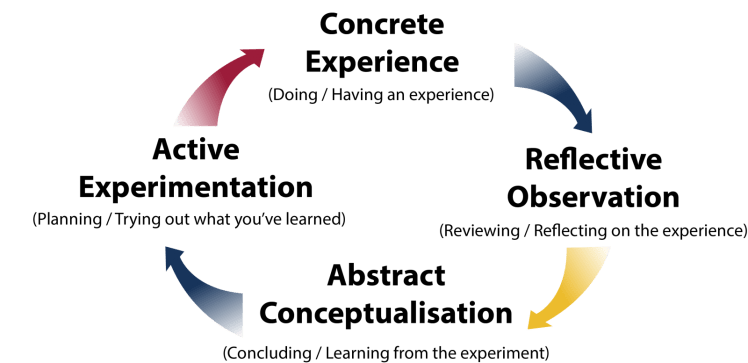
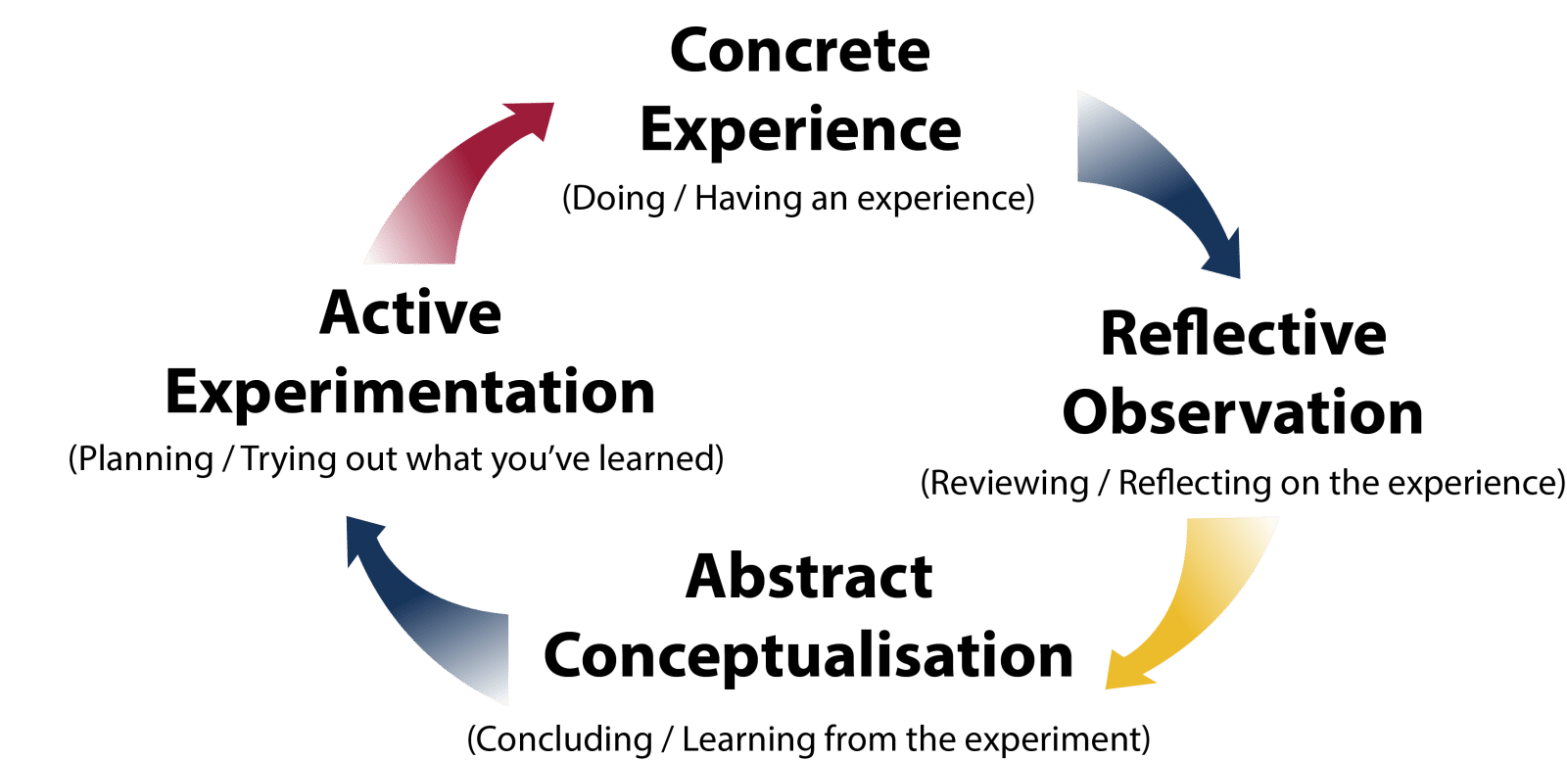
In reading over the students’ responses, and in thinking, again, of where many of them are.  Many are still moving around in a dimly lit place.  This is my purpose.  To move students from darkness to light.  It’s hardly a new idea, but it is one that many educators avoid…because it can be messy.  Not all students take to this, but the method is researched.  In fact, it’s based almost entirely on Kolb’s cycle of Experiential (reflective) Learning/Practice.  As Queens University explains it:

Experiential education is a philosophy that informs many methodologies in which educators purposefully engage with learners in direct experience and focused reflection in order to increase knowledge, develop skills, clarify values, and develop people’s capacity to contribute to their communities.

Who I am as a teacher is encapsulated in a singular statement of philosophy I was lucky enough to craft in 1997, barely 4 years into my career:  “When we trust our students, empower them to take charge of their learning, and offer the necessary guidance, they will astound us.”  Knowing how much guidance and when to offer it is key to the art of teaching, and I don’t always offer it at the right time for everyone.  I don’t connect with all students.  It’s something I’m working on…still… after 27 years.  As my friend Monte Syrie (http://www.letschangeeducation.com/  on twitter at @montesyrie) likes to say:  Do Reflect Do Better.  It’s become a mantra for me, too.

(Students’ views of the day below)

Period 3: 

What happened?

  • After the class commenced and all the students were settled into their typical circulatory seating arrangement, Mr. Heidt began to discuss the issues surrounding the two different demographics of students in the class: those who are familiar with Sir Garreth and those who are not. Although this barrier isn’t detrimental to the class itself, it is still a matter worth addressing. We were then divided into our assigned groups to come up with an analogy for this situation. Shortly after, each group shared their analogy, which brought us back to our own groups to discuss how we can improve these analogies and, more importantly, what we can do to improve the class itself.

So what?

  • The idea of comparing students who have had Mr. Heidt with those who haven’t has always been a popular trend throughout the school. But I never envisioned this concept being something that we actually took the time to discuss. Nevertheless, I can’t think of a better way to kick off the school year. By breaking this minor barrier, each of us will be able to strengthen our empathy (which is a significant aspect of the design process (which is what this class is all about (which is why I took this class (which is important because I want to look for new and creative ways to contribute to the unity of the class)))).

Next What?

  • The goal of this colloquium (I feel obligated to use big words in this environment) is to find common ground and a sense of unity between all students in the classroom in spite of their various histories and familiarities. While I do see this as very possible to achieve, and I do understand that this is the first time this class is up and running, I would not necessarily consider this to be the most important matter to discuss. It’s difficult to try and improve a class you haven’t taken, and it seems as though we’re spending a lot of time on problems that we haven’t even faced yet (or know that we will face). That being said, looking forward throughout the year, if we put our minds toward every issue the same way we’re putting our minds toward this one, then perhaps Mr. Heidt was being accurate when he said that we could become unstoppable.

by Jason S.

Period 9:

Why hello there folks. This next blog post was written by the one and only Gabi, who if you couldn’t tell by now, blogs in a very informal and unconventional way. SoSimu Liu Reaction GIF by Kim's Convenience grab a snack, a cozy blanket, and enjoy, because we’re about to embark on the blog post answering the following questions about Nova Lab today. What happened today? What does it mean? And What does that mean for us in the future? 
What happened today: We did a lot of things today, and only a very small amount of those things were shenanigans, because come on, it wouldn’t be us without some shenanigans. First and foremost, we discussed our reflections on the “Whole New Mind” excerpt that Mr. Heidt had us read over the weekend. (brain neuroscience GIF by University of CaliforniaWhich for me, was both confusing and enlightening, which I feel could also be the name of this class.) From our discussions, we came to several revelations. For one, we claimed that the world today has a bias against L brain thinkers, as in recent years, R brained thinkers have become more relevant in today’s society. However, to this, I must point out that there should be a balance, because if we have too much creativity without any control or logic, then chaos would soon follow suit. Then we moved on to talking about our personal mantras, to which mine was simple, but also stolen from a musical.jeff goldblum 70s GIF That musical would have course be, Dear Evan Hansen, therefore leading the mantra I chose to inevitably be “today’s going to be a good day, because You’re You, and that’s enough”
What does it mean: This means that (hopefully) we will keep in mindis how left and right brain thinkers are separated and how we can wall crumbling GIF by South Park see that in our everyday life, and hopefully be more aware of those separations, and (maybe, just maybe) begin to tear them down. In terms of the mantras we selected, we chose them in an attempt to have a purpose for each day, a certain goal to strive for, if you will. The hope with that is our mantas will help to lead us for each day, and the day after, and the day after, and the day after, etc. 

For the future: The goal for this is for us to be more attentive about the way we are thinking, in terms of thinking with both our left and right brains, our middle brain if you will. Our mantras will hopefully push us forward in our day to day lives. kenan thompson snl GIF by Saturday Night LiveAlright, enough of my thoughts about the day, back to your regularly scheduled program of Sir Garreth Heidt
By Gabi W.


*Featured Image at the top from: Queens University, Kingston.

Early Divisions & Design for Community

On Wednesday, August 28, just the third day of school, I offered to connect one section of my inNOVAtion Lab courses with an online community called “Modern Learners.”  (More information about them is found here.)  I’ve been a member of the community since its inception, and if you are an educator, you ought to check out the work the community engages in around changing school.

I’d opened the class to this opportunity because I framed the beginning of this new class as a story.  These students, 55 in total, over two sections, are pioneers/explorers, setting out to write the story of a different way to learn in our school.  The Modern Learners had set their August theme as “Story” and I saw an immediate connection.  So away we went.

IMG_0880
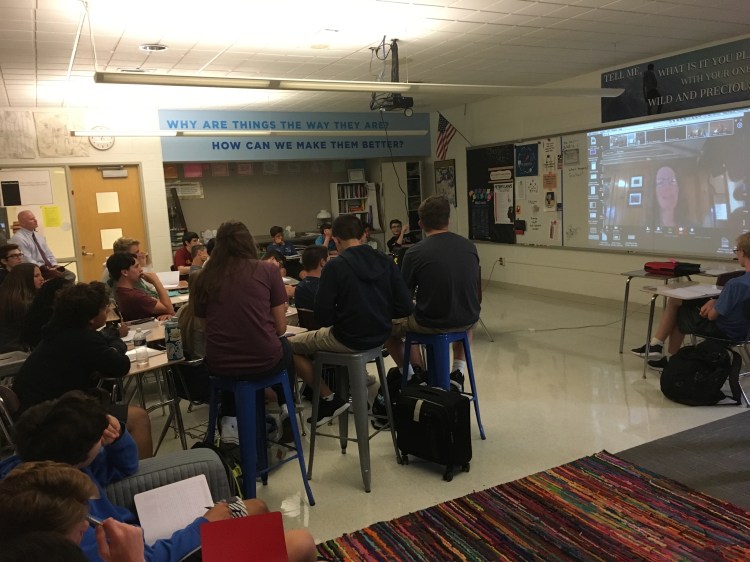
Part of NOVA Lab watching our chat with Modern Learners

While we had some technical difficulties, the chat lasted the better part of 40 minutes, and I was astounded at the initiative the students took to engage with the teachers, former teachers, administrators, etc on the other end.

But I was also troubled because something became clear to me…something that I’d realized on our second day but upon which I did not act.  The story of my realization and how I’ve offered this to the class as a problem through which we might not only make a tighter community but also learn a great deal about design thinking as a mindset that I want to make native to the class…that story is found below.

( I’ll post link to the hour-long video of the session if I can.)

“Dear Modern Learners:

My students and I wanted to thank you for engaging with us in the chat on Wednesday.  I sat down last night to watch the rest of it.  As much as I appreciate your recognition that my own presence in the class was a huge draw, that’s a double-edged sword, so I’d like to provide some background on it.  I wrote the following to Linda yesterday and thought I’d share it with you all.

“I had a feeling there would be talk about the fact that so many of the students had (already) such a strong relationship with me. The thing is that almost 1/3 of the students in that class, and all of the students who spoke, with the exception of Nadjia, had had me before in my gifted English classes. So there is already a year of understanding.

I thought about that all the way home yesterday because while it is nice to be admired, I’d rather not be seen as a sort of cult-leader (and students did create a “Cult of sir Garreth” several years ago, and I also have my own student-created Pokemon card).  Even admiration drives a wedge in the community between those who had me and know me, and those who don’t. I had to address that immediately.

So I used the design thinking mindset and tried to build empathy for those who had never had me and I thought about what it must feel like to be in the class but outside at the same time. I reached out to Doris (my design educator friend who was on the chat and with whom I’ve worked on design challenges through design thinking for almost a decade) and quickly created a lesson that we started today (Thursday), in both sections of Nova Lab, to “clear the air” and lead students into an actual design project (their first) to address the prompt, “How might we create a tighter community in Nova Lab?” I learned quite a bit listening to the students working together today. They were in groups where some students knew me and others didn’t. They had to develop empathy for each other’s stances and then create analogies or metaphors for their understanding of the problem. That “redefinition through metaphor” is important because it forces them to create statements that condense long explanations into a single image. In doing so they are further defining their own thoughts, defining the problem further (so important…designers spend a ton of time trying to make sure they are asking the right question) and learning how to use language to get others to “see what [they] mean.”

We have more work to do on this problem.  Students still have to ideate, prototype, test, and reiterate their solutions…but it’s clear to me that they are absolutely involved in this challenge.  1) because it applies directly to them.  2) because in choosing this class many of them expressed the desire to be part of something different and new. (this from their discussion on Monday in response to “Why did you take this class?”)  Because of number 2, many of them are already vested in helping to create a “legacy” through this class.

But the crucial  part here, and what separates design thinking from traditional means of problem-solving, and what links it to the particular mindset I carry from my work as a writer, is the necessity of “lingering at the point of wonder.” That is, Designers realize that contemplating the problem, really empathizing with users…this is key to making sure you’re solving the right problem.

Importantly, I had to counsel students to avoid coming up with solutions.  You wouldn’t be surprised to learn that when I issued the challenge, the first thing most of the students did is to start thinking of a solution.  (Always looking for the right answer.  Isn’t that what school is about…what being a “really intelligent” person is about?)  So I had to pull them back, to linger at the points of empathy and problem definition so that they could look for many possible solutions, not just “the right one.”

Getting them to slow down and discuss the challenge and learn about each other…amazing discussions ensued!  Including the fact that several groups decided I was wrong…there aren’t just two groups in the class, there are actually three or more.

Anyway, I’ll keep you updated as to how the class works through this challenge.  I’ll be blogging about it on my own blog, and students, each day, one from each class, will post on www.pvhsnovalab.wordpress.com.

Nova Lab Day 4–The Challenge and Promise of Community

(For most of the rest of the year, students in NOVA Lab will be blogging their reflections on the day’s events.  Here is the next chapter in our story)

Period 3–

Today in class, we gathered in small groups and discussed our first thoughts on A Whole New Mind. We talked about how the reading was important not only for the class but for all students our age. The conceptual age that Pink, the author, talks about is the future us students will live in, so it is important to understand what is coming.

After this, we began to investigate a problem in the classroom. There is a clear divide between those students who have had Mr. Heidt and those who haven’t. The students who haven’t had Mr. Heidt before seem to be less comfortable in the class because they are not as familiar with how Mr. Heidt teaches. In our groups, we started the design process to find solutions to the problem. We are currently in the “Define” part of the process, where we are getting a better understanding of the problem. In the next class, and in the coming week, we will be coming up with potential solutions to the problem and exploring the design process. It is important that we resolve this issue, as it will strengthen the community we are building and allow the students to collaborate more effectively in the future.
Brandon S.

Period 9–

The class began with everyone gathered in the usual circle of desks. Mr. Heidt began by reflecting on his recent concerns with Nova Lab.  He discussed the clear divide between the students he had taught in previous years versus those he had not. The latter group, not having the same experience, caused an unequal foundation.  To solve this issue, he introduced the class as a whole to design thinking. This tool will then be used to flesh out and test ideas throughout the course.

After being introduced to design thinking, Mr. Heidt separated the large classroom into several small groups. Our objective was to utilize design thinking for coming up with solutions for the classroom dynamic. The separate groups used the first two aspects of design thinking, empathy and define, to analyze the gaps caused by a lack of prerequisite coursework with Mr. Heidt. The rest of the design thinking process will be expanded upon in future classes.
Andrew V.

Books, Articles, and Other Resources for Student Entrepreneurs and Innovators

Books

Start it Up–The Complete Teen Business Guide to Turning Your Passions Into Pay.
by  Kenrya Rankin Naasel

Podcasts/Webinars

How to Be a Better Presenter: IDEO Univ. Webinar with Prof. Storyteller and User Interface Designer (includes link to webinar)

Videos and On-line Presence

Project and Time Management

Project Idea–Food Waste

I found this article today on one of my news feeds.  Opportunities are everywhere.  Read about it!

Now is the time, here is the place, we are the one.

If we look at this seriously, research and define a problem scaled, perhaps, to the realities of what a group of students can do…?  Who knows?  Why are things the way they are?  How can we make them better?

Also, check out the work Open.ideo has done so far on this topic.

NOVA Lab Day 3–The students take over

The following posts were written by students in Mr. Heidt’s 3rd and 9th period Nova Lab courses.  Take a look at what we’ve been doing.

Period 3:

Today’s innovative learning was based around a book called A Whole New Mind written by Daniel Pink. The book talks about how our brains have a left side and a right side, each specializing in certain tasks. We read a small excerpt from the book and wrote in the text if we had any questions or comments about the writing. In a very short summary, our left side is analytical and methodical based, while our right side is more creative and artistic. Our world is shifting from one that craves left-sided workers to one soon dominated by right-minded innovators. After reading, we did a 5-minute “first thoughts” freewriting (nod to Bard College’s “Institute for Writing and Thinking) where we wrote about our initial thoughts, questions, rebuttals, etc about the read. 

The start of any business is hatched from an idea; from a plan. Just like a business starts, our innovative class has to start from a mindset. Having a clear and strong mindset is arguably the most important part of becoming an entrepreneur, as without a mindset it’s nearly impossible to stay focused. Reading this passage and writing about it helped to get us in the mindset for thinking like innovators. 

While it’s a great start to read and write about having a strong mindset, it does absolutely nothing for us unless we get up and act on it. In order to make a change, we have to go and make it happen. Accumulating knowledge and information in crucial to success, but now the task is to go out and make something happen. In the upcoming weeks, our class will be focused around redesigning our innovation space. We must use the knowledge from the book, and combine it with the mindset to make a difference so that we can learn, grow and create a positive change in our school.
–Garrett R.

Period 9

On Wednesday afternoon, the Modern Learners, Mr. Heidt and his design colleagues, and NOVA Lab students met over video call to discuss the class, its content, and its place within the wider education system. The Modern Learners directed most of the questions, a list which included:

  1. Why did students choose the class?
  2. How will students collaborate?
  3. How will students document their process?
  4. How does the class affect your mindest about school?
  5. What changes to the class made it attractive?
  6. Did any students have project ideas yet?
  7. How will the projects connect to one another and the wider world?
  8. What was the conversation with your parents about the class?

Numerous students gave answers as they wished, with the hope of informing Modern Learners  about the class and how it might fit into their broader mission to keep schools relevant.

The answers given by the students may provide some insight as to how to keep school relevant using design curriculum and/or classes. For example, in answering how this changes our mindset about school, one student answered that the learning shifted from being solely intellectual to pragmatic. Adults don’t sit in lectures all day; they take what they’ve learned and apply it to real situations, and NOVA lab has been billed as a class which bridges that gap that other classes can’t seem to fill. With this hint of design as an effective means of keeping school relevant, the next question that arises is how to pitch these classes to institutions and people unfamiliar or uncomfortable with the topic. What came through loud and clear here is that authentic interest by the teacher can inspire students to evangelize to their friends, creating grassroots movements that put the class on the schedule.

What to do next varies based on which group you fall into. For the students, the next steps will be to keep track of their progress throughout the year to see how their experiences or ideas change. If the class was supposed to get out into the real world and we can’t, then something needs to change (and quickly). They need to make sure the class lives up to the expectations they’ve set. For the Modern Learners and friends, the next step is to monitor and advise the class externally. If the aforementioned problems do arise, they need to offer their assistance to right the class’ track and ensure the experiment at least reaches its intended conclusion. Once we have more class to analyze, they can then look more closely at our answers to the questions and see whether this is an effective way to keep schools relevant.
–Matt T.

NOVA Lab–Second Day Reflection

One of the things we’ve discovered is that there are many ways to develop an entrepreneurial mindset.  Today was a great example.

After we touched back on the contributions we made yesterday about the story of why we took this class, Mr. Heidt introduced us to the poem below.

Mary Oliver--The Summer Day

While it might seem a poem is a strange intro to the entrepreneurial/innovator’s mindset, Mr. Heidt made it fit by connecting it with our class tagline:  “A space for innovation aspiration, respiration, creation.  He led us through a series of 4 freewritings about the poem wherein each one connected to either innovation, aspiration, respiration, or creation.  The questions themselves were as follows:

  • What inspires you in this poem? 
  • How does it ask you to aspire? (Does it create aspirations in you?)
  • Does it create space to breathe? (yes, no…why/how?) 
  • What will you create of yourself?

After we wrote for two minutes on each question, we had to approach our group “posters” and choose one line from out freewriting that we felt rang true for us.  Then, as groups, we wrote them on the backs of your posters.

These insightful nuggest of thought were chosen (1/student) as a way of gaining insight to the human mind or co other iterations thereof.