Innovate with IN(diana)

While we’re not Hoosiers, the work some of these young entrepreneurs and innovators from Indiana have done can certainly inspire us in our own endeavors.  Remember…It’s not easy, a view on the human at the center of your problem, and a lot of empathy, you’ll come up with an idea and might end up just like these students.   Even if you don’t you’ll get a lot of ideas by watching these videos.

Also, Scroll to the bottom of the page to check out tips on how to get far with your project from the 2018 winners, Educaid.

PA Dept. of Transportation Design Challenge

Wolf Administration’s “Innovations Challenge” Invites Students to Develop Technologies, Solutions to Combat Roadway Litter

Harrisburg, PA – The Pennsylvania Department of Transportation (PennDOT) and the Pennsylvania Department of Environmental Protection (DEP) announced today that students in grades 9-12 are invited to participate in the third PennDOT Innovations Challenge which encourages students to use their problem-solving, creative and strategic-thinking abilities to solve real-world transportation challenges in a competition among their peers.

This year’s Innovations Challenge asks students to look at cost-effective technologies and innovative solutions – aside from laws, programs and educational campaigns – that can be developed in the next five to 10 years to help PennDOT more efficiently, effectively and safely control litter along roadways.

Last year, PennDOT spent nearly $13 million cleaning up roadside litter across Pennsylvania.  In addition, nearly 5,000 volunteers spend countless hours participating in the Adopt-A-Highway program each year. These dollars and volunteer hours could have otherwise been spent on delivering a better transportation network and making Pennsylvania a better state in which to live.

“While we are grateful for the selfless actions of our thousands of Adopt-A-Highway volunteers, we continue to look for ways to curb the amount of roadside litter across Pennsylvania,” said PennDOT Secretary Leslie S. Richards. “Through the PennDOT Innovations Challenge, students can develop a long-term, sustainable solution to address this ongoing challenge, and make Pennsylvania a cleaner and more beautiful place to live.”

“In addition to a public health hazard and eyesore, the litter along Pennsylvania’s roads is an environmental problem, degrading soil, water, and wildlife,” said DEP Secretary Patrick McDonnell.  “DEP is excited to support this opportunity to have young innovators bring fresh solutions to this longtime problem for the benefit of current and future generations of Pennsylvania.”

The Innovations Challenge aims to not only help students explore real transportation challenges that PennDOT is facing, but also open their minds to the very real possibility of working for PennDOT after graduation.

“Engineering and equipment operator positions are key to building and maintaining Pennsylvania’s vast road and bridge network,” Richards added. “However, PennDOT employs more than 11,000 Pennsylvanians from a wide array of educational backgrounds in nearly 400 job classifications.”

Regional Innovations Challenge winners will be selected and invited to compete in Harrisburg for the state championship. This year, the Pennsylvania Chapter of the American Traffic Safety Services Association (ATSSA) and the Keep Pennsylvania Beautiful (KPB) organization are providing a combined total award of $3,000 to be divided among the first, second and third place statewide winning teams.

For complete Innovations Challenge details, visit www.penndot.gov/innovation. The deadline for submissions is December 20, 2019.

MEDIA CONTACTS: Jan Huzvar, PennDOT, 717-783-8800

Deb Klenotic DEP, 717-783-9954

# # #

Michael S. Taluto| Safety Press Officer

Pennsylvania Department of Transportation

District 4-0 Office

55 Keystone Industrial Park | Dunmore, Pa 18512

Office 570.963.3502 | Fax 570.614.2957

www.neparoads.com * www.511PA.com


Featured Image from: https://www.changingtides.global/blogs/our-blog/pick-me-up-the-story-of-litter

When a Plan Comes Together

Since Phil Holcombe’s Monday discussion with our classes on the value and methods of branding, we’ve been discovering the common signals that seem to emanate from the documents we’ve explored about this class and others like it.

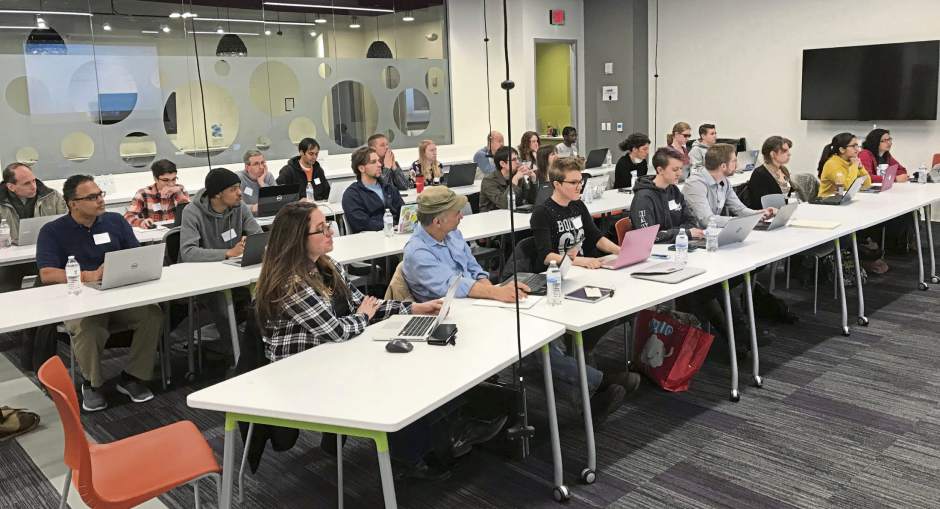
Today we got to the point where the two classes had (as smaller groups) defined their common signals and studied the common signals in light of our mission, vision, and values.

IMG_0937

The students were helped along in their evolution of thought by the creation of Point-of-View statements, each group receiving a different stakeholder to design a persona for.   One group received notice that their user was a student who knew nothing about NOVA Lab.  Another group received a member of the school board who knew little about the class.  And another was asked to create the persona for an administrator in the building who knew something but not much.

The magic in the creation of these personas was beautiful.  I wasn’t sure how the trip would be taken by the different groups, but I was sure we’d end up closer to understanding our brand and our marketing task.  And I wasn’t wrong.

The group who was given the generic character of a student who knew next to nothing about NOVA Lab came up with:

“The inquisitive, perplexed, dynamic) high school student needs to find a course that makes him/her feel that their ideas matter because it will make them feel secure in combining their creativity with their academics.”

This was amazing because it shows a good deal of empathy* for a group of people who are not even in our class but who very-well should be.  They nailed the “feel” section of the statement as well.

Another group who had received “a parent of a student thinking about the class” created this persona:

The skeptical, weary parent needs to attain information in a way that makes him/her feel reassured because she is unsure whether the class is productive or not.

I pointed this out to the students, but here I want to say two things.  First, I’ve learned so much by listening to and watching the creation of these statements.   Students dug into their own experiences or revealed discussions they’d had with peers or faculty, all in an effort to help make what we do in NOVA Lab more transparent and move it from something people take because they believe in the concept to something they will take because of the things we DO.

361gwdWe’ve started the doing, and if this is any indication of the capabilities of this community of learners, I’m going to be writing a boatload of effusive posts.

We’ll be putting the branding on hold, most likely, until we have a number of student projects in the hopper.  Following the question of one of my students about “How do you design for something that you don’t even have yet?” Phil Holcombe’s response was “give it time and space”

And so we shall.

*  Of course, if we want to be a stickler about it, this is very low-level empathy building, and the kids know it.  The next step (and some of them already talked about it) would be to go out and do empathy interviews with the different people behind their persona’s.  But I don’t want to turn this, at least not right now, into a year-long project in brand creation.  If some of the students want to devote time to that because the learning they are taking away from it feeds their ideas for their future college or career lives, that’s great. 

I have been to the Mountain Top…

I ran across this article today and was reminded of some of the background work that went into the creation of inNOVAtion Lab.  In the summer of 2015, accompanied by my superintendent and our STEM coordinator, I visited Lehigh’s Mountain Top Program.  We were led through the space by Dr. Sarah Stanlick.  The immensity of the space was matched only by the immensity of the scope of the students’ projects.

Our visit to the Mountaintop was precipitated by our district’s slowly growing focus on student-driven learning.  After hearing about the program from a neighboring district’s Director of Learning and Innovation, I knew we had to visit.   I wasn’t disappointed.  The space and the work we could see all exuded a feeling of authenticity and students who owned the learning.

I knew, after visiting Moutaintop, we could do this at my district.

While it may have taken a few years, we achieved a semester-long iteration of the class and then, a few years later, a full year during which students learn about innovation, project management, and how to take charge of their own learning by setting goals, determining criteria for success, and employing  design thinking as the heuristic that drives the learning.

inNOVAtion Lab is that class.   We’re on a roll.  Follow our progress as we transition from guided projects to student-driven work over the next few weeks.

Thank you Lehigh University for helping us find our way to new, purposeful learning experiences for our students.

featured image via Jessica Kourkounis for The New York Times

Philadelphia Tech Elevator

Wondering if Coding is for you?  Want to know if you have the calculatory “chops” to crank out C++, Java, and other languages?

Check out the Philadelphia Tech Elevator, a coding bootcamp that might set you up for a future of coding and creating a better world…virtually speaking.

stacked-logo

They have a free aptitude test and you can take it online.

Click here for more information.


*featured image found here


Who’s Telling Your Story?

Today the students in NOVA Lab got a chance to hear from the undergraduate director of Industrial Design at University of the Arts in Philadelphia, Phil Holcombe.  Phil is also the principal designer at the Educational Design Consultancy, Form & Faculty.

The students’ first real-world design challenge is to help create the brand and story of the class itself.  So, after doing a deep dive last week into the texts and supporting documents that have helped shape the class, they have set to the task of listening for the recurrent “signals” in those texts that they can then “amplify” through different modes of branding.

1-Moz-for-brand-storytelling-examples
 Image Source: Moz

Phil’s discussion today was based on the work he has done in the past building brands for his own company as well as larger organizations, like the Smithsonian Institution.

Phil lead off with a definition of branding that might have caught some of the students off guard:  “Branding is not the story you tell the world about yourself and your company, it is the story they tell about you when you are not around.”  There’s a lot to unpack in that simple statement, none the least of which is the ethical dimension inherent in the phrasing.  Namely, if we want to be seen as authentic and genuine, then we cannot pretend otherwise.  It seems so self-explanatory, but you’d be surprised at how many people forget the need to do just that.

The students were on their A-game today, asking probing questions about good brands, overbranding, and how to brand when you don’t even have a product yet.

Our story is still being written, and I imagine it will be for some time to come until we get more comfortable with the discomfort of not always knowing which way we’re going.  One would think that after almost 15 years using design thinking and similar methods of self-determined learning in the classroom that I’d have more of a grasp on things.

I don’t

Every class is different.  They need different things, have different gaps, are stronger in some areas than in others. The art of the thing is in knowing how to spot the differences, and in knowing how to help them discover what they need.

Somehow that is part of our story…part of our brand.  It’s a difficult story to get others to tell when we’re not around.  But it’s our story, and we’re sticking to it.

*featured image courtesy of: https://elearningindustry.com/storytelling-for-elearning-tips-strategies-examples

Branding, Defining, and Suring Foundations

This student reflection gives some insight into where we are and why.  I’m not going to comment beyond pointing to the way this author posits ownership over clarifying the brand of the class in the last paragraph.  Don’t know if I could ask for more.  There’s much work to be done, but with students like these, who wouldn’t look forward to it all.  (Though I will say that a lot of this “dis-comfort” probably stems from the rhizomatic nature of the learning I’m engaging them in.  (See my post from earlier today on that.)

pics_interiors-ii_t2v6491-edit1

What Happened?

Today’s class started off with the students splitting up into small groups of about 6 people.  We were continuing the activity from yesterday, where we were all given 8 articles to read regarding the class itself.  The articles ranged from the original proposal for the class, to the parent email for the course, as well as postings made by other design thinking aficionados.  Everyone in the group read one or two of the articles, so that every document was read. While reading, we all were looking for themes that stood out to us. My group in particular used common words and tones to illustrate the similarities between all of these very different articles.  After we read, we created a common list for all of the words and phrases that stood out, then used that list to create an image for the class itself. 

So What?

The past few days, the class has been focused on creating a brand.  We have been working on creating a clear image of what the class is, as many people don’t automatically understand what innovation lab is.  By using the written materials talking about design thinking and the class itself, we came up with common themes that defined all of the class and the processes used within NOVA Lab.  Having these common themes made it so easy to create a logo/image that represents the class itself.

1_qNdl4IMI0Ri2h5C5_FEn9Q

Next What?

After this logo, we plan to continue to work on defining the class. Presenting a clear and concise idea of what the class is to the public will help us, as students, better understand the class. I’m excited to see where this takes us, as one of the things I have been writing about in my personal journal is that the definition of the class seems a little shaky.  The logo and other class branding activities will definitely stamp all of that uncertainty out. Hopefully, this also helps the rest of the class feel as though we have a solid idea of what and who we are, before we focus on who others are and begin designing for those other people.

Rhizomes, Design Thinking, and Learning

This week has been a true learning curve for me.  And I say that after 26 years in the classroom.  I still have much to learn.

Extraordinaires Design Characters Banner (1)

We began the week by finishing up our design sprint using the Extraordinaires Design Studio.  Students completed a run-through of the Design Thinking (DT) cycle and sketched a potential solution.  This wasn’t something new to me.  I’d done it before (see this lesson plan), but in different contexts, and with different audiences.  So I felt confident going in.

Oh!  Confidence.  You cruel mistress.  I skipped some key context building and, while I did model the process, I didn’t check for total understanding.  So, in the end, the student feedback on the process that DT define, and this activity in general was less than stellar.

Design Thinking Process--IDEO

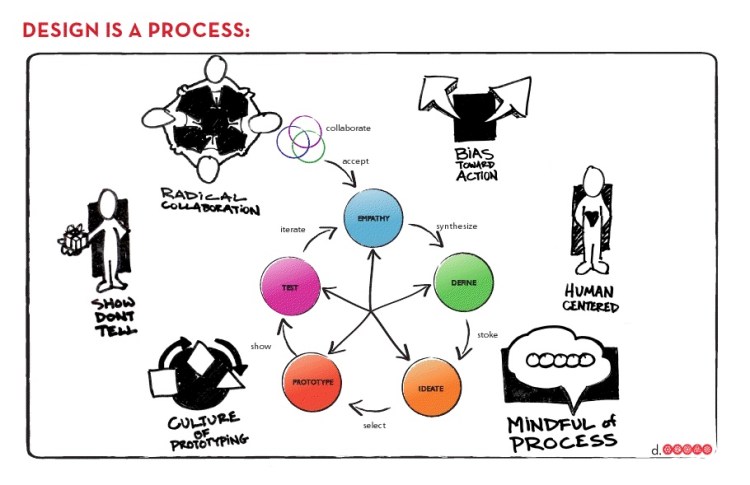
That’s troubling as DT is one of the cornerstones of NOVA Lab.  The way I’ve envisioned the class relies on DT as a methodology for problem finding and solving.  that means that the students have to understand the mindset of DT and employ it.

But let’s say that the failure here is mine.  I’m mired in self-doubt and perhaps the notion that this was a failure is mostly mine.  What’s more important is where we go from here, and how.

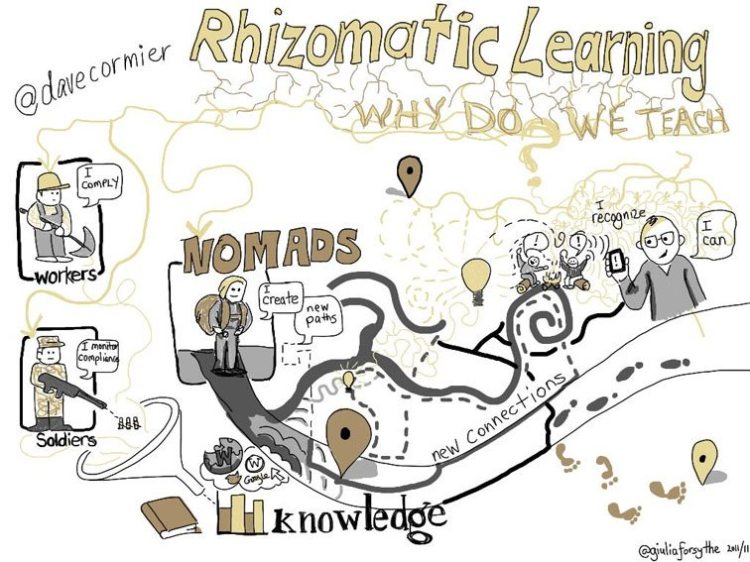
rhizomatic-learningI’ve been doing a great deal of reading over the past few weeks on Co-Authoring and Co-Designing classes with students.  The impacts of providing such agency are not only tangible, the method itself is forwarded by numerous recent studies.  David Cormier’s work with “rhizomatic learning”  is foundational in the kind of self-determined, heutagogy I’m after.  Further, the work of these designers in bringing a designerly mindset to the act of learning of teaching certainly reveals an affinity between rhizomatic learning and the methodologies of DT.  In the end, the work of Doris Wells-Papanek and Luigi Pecoraro tie both these structures together through a use of a design-inspired managerial system for learning.

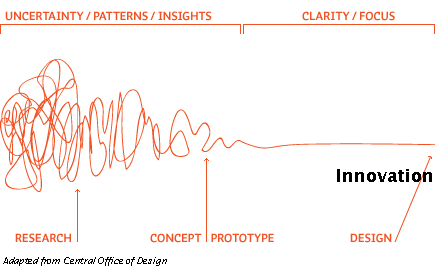
Design squiggle to project--creative processThus, while my students and I may be mired in the squiggled middle of the design process, we cannot forget that the ends we are designing for necessitate a “messy middle.”  While we/I may have a definite “north star” for the class, the journey that gets us there is not clear, set, or definitive.  Like a hero’s journey, we have numerous trials to overcome before we realize the potential each of us possesses.

And that is as it should be.

Trust the process.

NOVA Lab–Procedural Info: Grading

Many of you know that I have been shifting, slowly and imperfectly, from using grades (a habit born of . . . oh . . . a lifetime of being graded, earning grades, needing the approval of others, and, of course, “giving grades.”

For years I played that game, and I was (am) GOOD at it.  And then, some time ago, I realized that the game served no one well if what we were after in education was deeper learning.  An anecdote will serve best to illustrate here.

I recall being in a class on creativity and discussing with the presenter how I felt I had to go back to college so I could write a book (about water towers and, possibly, urinals).  The presenter looked at me and asked, “Why do you feel you need to go back to college to do that?”  And it hit me…hard…hard enough that now, 22 years later, I still see myself in that seat, at a motel on 309 in Montgomeryville, PA surrounded by over 50 other teachers.  And I feel my mind go…”Ooooohhhhhh.  Well lookie there.  Somebody found you out.”

‘See, I needed someone else’s approval of my work to make it “good enough.”  And where did that come from?  From being good at the game of school.  I didn’t realize it, but I literally NEEDED school to make me and my ideas feel valuable.

Indeed, when it came to learning, I rarely thought of it.  I thought more of being a good student.  I was the guy having this discussion:

I’m not that way anymore.  I’ve grown, which, in the end, is what learning is all about.  I changed myself because I learned.  It took a while, but I finally got the courage to ask myself:  “Why is this (schooling and grades) the way it is?”  What I found led me to nothing but treating humans as objects to be ranked, sorted, and divvied out into a workforce where, for little return, human labor is sold to others who profit in far greater ways than the laborers.  And so I asked the next question:  “How can we make it better?”  I found others in the same stage of evolution, many others, and together, we’re working towards something different.  IT IS NOT EASY.  IT IS NOT THE MOST EFFICIENT METHOD OF ASSESSING LEARNING.  But it is the most humane.  And I deal in human beings not objects of labor. (Though, of course, work is part of what gives our lives meaning.)

Anyway, when it comes to grades in this class, in all my classes anymore, we have to think different.  Here’s a link to the grading page in Nova Lab’s class overview.

Let’s talk about it.

Reflecting, Projecting: Co-Designing Curriculum

The past few days we spent doing quick presentations of our Extraordinaires Design Studio projects.  Afterwards, we reflected on the learning coming out of that experience and how it sets us up for what’s to come.

Additionally, we’ve been thinking and pooling our ideas about co-designing the curriculum.

CoDesigning Curriculum

Where do we need/want to go?  How can we get there with the minimum of disturbance and a maximum of learning?  Lists will be placed in the space below after class tomorrow.


This slideshow requires JavaScript.

Ideally, we’re working through several cycles of Kolb’s methods for experiential learning.  Again, student work and reflection will fill in the blanks.

learning20cycle_v3


Also coming up…The introduction to http://www.projectwayfinder and our journey for lives of purpose that will inform and provide the foundation for all the work we do.